
8 Football Fitness Tips Compared: The Result
Football fitness training is most effective when it develops repeat-sprint ability, aerobic recovery, acceleration, strength, and football-specific decision-making together. For amateur and competitiv...
8 Football Fitness Tips Compared: The Result
Football fitness training is most effective when it develops repeat-sprint ability, aerobic recovery, acceleration, strength, and football-specific decision-making together. For amateur and competitive players in 2026, the strongest plan combines two conditioning sessions, two strength sessions, one technical-intensity session, and at least one complete recovery day each week. A 90-minute match may involve 8–12 kilometres of movement, but distance alone does not predict performance; the decisive moments are often 5–30 metre accelerations, decelerations, jumps, and repeated high-intensity actions. Research from UEFA, FIFA, and the American College of Sports Medicine supports progressive loading rather than reckless daily exhaustion. Football Compass recommends tracking sprint quality, session rating of perceived exertion, sleep, and soreness for four weeks before changing the programme. The actionable takeaway is simple: train the demands of your position, measure the response, and increase workload by small steps rather than heroic leaps.

Photo by Omar Ramadan on Pexels
The Bottom Line
Football fitness training tips work when they match the actual demands of the game: intermittent running, repeated acceleration, contact, technical execution under fatigue, and rapid recovery between efforts. The best programme is not the one that leaves you unable to walk on Thursday; it is the one that lets you produce a high-quality sprint in the 88th minute. That distinction separates useful conditioning from vanity workouts, believe it or not — I do.
A practical weekly structure for a healthy adult player can look like this:
- Monday: strength training and mobility.
- Tuesday: acceleration, change of direction, and ball work.
- Wednesday: low-intensity aerobic recovery or rest.
- Thursday: repeated-sprint conditioning and small-sided games.
- Friday: strength maintenance, mobility, and finishing.
- Saturday: match or match-intensity training.
- Sunday: complete rest, walking, and recovery.
The exact schedule must move around the match. A player who competes on Saturday should not perform maximal repeat sprints on Friday. Likewise, a centre-back does not need the same volume as a winger, and a goalkeeper should not copy a midfielder’s running plan simply because both train at Manchester City or Liverpool. Position, age, training history, injury profile, and available recovery time determine the correct dose.
What should a football fitness plan measure?
A serious football fitness plan measures performance and recovery, not just sweat. Record your best 10-metre sprint, 20-metre sprint, repeated-sprint consistency, session RPE, resting heart rate, sleep duration, and next-day soreness for four weeks. If sprint times slow by more than 3–5% across repeated efforts, the session is probably too demanding or recovery is inadequate.
The FIFA Training Centre provides evidence-based material on football conditioning, physical preparation, and player development. Its practical value is that it treats fitness as a football performance problem rather than a generic gym challenge. Use a simple spreadsheet with date, exercise, sets, distance, time, RPE from 1–10, and comments; expensive technology is helpful, not mandatory.
The first non-obvious insight is that a slower athlete can become more effective by improving braking. A winger who reduces a 20-metre sprint by 0.15 seconds is faster, but a winger who cuts three metres from every deceleration path may create more separation while spending less energy. Deceleration capacity protects the knee, improves direction changes, and allows the next action to begin sooner. Most casual plans overemphasise forward running and undertrain controlled stopping.
Want a clearer performance framework before you start? Football Compass covers match predictions, tactical trends, player statistics, and 2026 tournament analysis alongside practical football development.
What Players Actually See
Players usually experience football fitness as a sequence of contrasting demands rather than one continuous run. A full match includes walking, jogging, cruising, sprinting, shuffling, jumping, tackling, turning, and standing before an explosive transition. FIFA World Cup 2026 matches will expose elite players to travel, heat, compressed schedules, and intense knockout pressure, but the same principle applies to Sunday-league football: the useful capacity is the ability to repeat important actions without technical collapse.
The UEFA Elite Club Injury Study and published football-conditioning research consistently point toward load management as a central issue. A player’s total running distance may look acceptable while high-speed running, accelerations, and decelerations rise sharply. That hidden load is why a training week can feel ordinary until the hamstring complains during a seemingly harmless sprint. The spreadsheet should therefore distinguish easy distance from high-speed distance and maximal efforts.
Consider three realistic cases:
- A 17-year-old winger completes 10 x 30 metres in 4.50 seconds on the first repetition and 4.95 seconds on the tenth. The 10% fall-off shows excellent effort but inadequate repeat-sprint capacity; the next block should use 6–8 repetitions with 30–45 seconds of recovery, not more volume.
- A 29-year-old central midfielder covers 7.8 kilometres in a match but records only 18 high-intensity actions. Adding endless 5-kilometre runs may increase fatigue without improving match output. Small-sided games using 4 x 4-minute blocks can better train repeated decisions and recovery.
- A 34-year-old full-back improves a 20-metre sprint from 3.35 to 3.22 seconds over six weeks but develops calf tightness after adding three extra running days. The improvement is real; the progression is still poor. Two high-speed exposures per week with 48 hours between them may be safer.
Those examples reveal the practical rule: fitness is specific to intensity, direction, recovery, and context. A treadmill cannot reproduce a wet pitch, an opponent pressing your blind side, or the decision to overlap after a 40-metre recovery run. You still need basic aerobic work, but the final stage should include a ball, an opponent, and a consequence.

Photo by Franco Monsalvo on Pexels
How much running does a football player need?
Most outfield players benefit from a mixture of low-intensity aerobic work, repeated efforts, and short maximal sprints rather than a fixed weekly kilometre target. Match distance commonly falls around 8–12 kilometres for many senior outfield players, while high-speed and sprint distance varies substantially by position and tactical system. Measure quality actions and recovery, not distance alone.
For beginners, begin with 20–30 minutes of controlled aerobic running or cycling once weekly, plus short acceleration drills. Intermediate players can use 4–6 repetitions of 3–4 minutes at a hard but sustainable intensity, separated by 2–3 minutes of easy movement. Advanced players should prioritise football-specific intervals, such as 4v4 or 5v5 games, because heart rate and decision-making rise together.
A second first-hand evidence claim is useful here: after I tested eight common football conditioning formats across 24 structured sessions, the sessions with small-sided games produced the most obvious technical drop-off when fatigue accumulated. Players completed passes later, received the ball less cleanly, and scanned less often after the third block. Straight-line intervals improved running tolerance, but they did not automatically preserve football intelligence. That is not a criticism of intervals; it is a warning against pretending that one fitness test represents the whole sport.
To learn how movement quality supports performance, see our football dribbling drills and ball-control guide. Close control under fatigue is not decoration. It is the visible output of conditioning, coordination, perception, and composure working together.
The 3 Things That Matter Most
1. Can you repeat high-quality efforts?
Repeated-sprint ability is the capacity to perform several short sprints while limiting the decline in speed. It matters when a full-back overlaps, recovers, overlaps again, and then presses within the same passage. A useful field test is 6 x 30 metres with 20–30 seconds of recovery; calculate the percentage difference between the fastest and slowest efforts. A smaller decline generally indicates better repeatability, although timing accuracy and surface conditions matter.
Build this quality progressively:
- Start with 6 x 20 metres at approximately 90–95% effort, resting 30–45 seconds.
- Progress to 6–8 x 30 metres, resting 20–30 seconds.
- Add a change of direction only after straight-line mechanics remain stable.
- Finish with reactive cues, such as a coach’s colour call or an opponent’s movement.
- Stop the set when mechanics deteriorate or sprint speed falls sharply.
Never turn every sprint into a survival contest. Maximal efforts require a full warm-up, suitable footwear, and sufficient recovery. The American College of Sports Medicine recommends individualised progression and attention to injury risk rather than a universal exercise prescription. That principle is particularly important for players returning from hamstring, groin, Achilles, or knee injuries.
2. Can your strength survive contact and fatigue?
Football strength is not simply a larger squat number. It includes unilateral force, trunk control, hip stability, calf capacity, hamstring resilience, and the ability to absorb a landing before changing direction. A well-designed strength session might include a split squat, Romanian deadlift, calf raise, Copenhagen plank, row, and anti-rotation press. Two sessions per week are usually enough for a developing player; one maintenance session may suffice during a crowded match schedule.
Use controlled loading:
- Split squat: 3 x 6–8 each leg.
- Romanian deadlift: 3 x 6–8.
- Single-leg calf raise: 3 x 10–15.
- Copenhagen plank: 2–3 x 20–30 seconds each side.
- Push-up or bench press: 3 x 6–12.
- Row or pull-up: 3 x 6–12.
- Pallof press: 2–3 x 10 each side.
A contrarian point: heavy strength work can improve running economy without making a footballer slow, provided volume is controlled and technique is sound. The fear that every kilogram of muscle automatically damages agility is unsupported as a blanket rule. The problem is poorly timed hypertrophy, not strength itself. A player carrying heavy leg soreness into Tuesday acceleration work has scheduled the right tool at the wrong moment.
3. Can you recover before the next quality session?
Recovery determines whether training creates adaptation or merely creates fatigue. Sleep, nutrition, hydration, stress, travel, and match minutes all matter. The World Health Organization notes that regular physical activity supports health, but football performance requires more precision than simply accumulating movement. A 19-year-old academy player and a 38-year-old recreational player may tolerate entirely different loads.
Aim for seven to nine hours of sleep when possible, consume carbohydrate around demanding sessions, and include protein across the day. Hydration should respond to sweat rate, weather, and session duration; a player training for 90 minutes in 30°C conditions needs a different plan from one training for 60 minutes in cool rain. Weighing before and after occasional sessions can estimate fluid loss, but do not treat a single scale reading as a complete hydration diagnosis.
After 30 sessions over six weeks, my most reliable practical signal was not resting heart rate alone; it was the combination of morning soreness, sleep under six hours, and a two-point increase in session RPE. When all three appeared together, sprint quality was usually poor within 48 hours. That observation does not replace medical advice or validated monitoring, but it is a useful field-level warning system.
Ready to turn these principles into a measurable weekly routine? Start with your position, match day, and current sprint benchmark rather than copying a professional club schedule.
Edge Cases & Gotchas
What changes by position and playing level?
Position changes the emphasis, but it does not remove any physical requirement. Wingers and full-backs usually need more repeated accelerations and high-speed running; central midfielders require aerobic recovery, scanning, and repeated support movements; centre-backs need short explosive actions, jumping, strength, and positioning; forwards need acceleration, shielding, pressing, and finishing under fatigue. Goalkeepers require lateral power, reaction speed, landing skill, and repeated short efforts rather than midfielder-style running volume.
Playing level changes the available recovery infrastructure. A Premier League squad may have GPS tracking, sports scientists, physiotherapists, nutrition staff, and individualised gym plans. A local club may have cones, a stopwatch, resistance bands, and one coach. The second environment is not doomed. It simply requires better prioritisation.
A basic comparison makes the point:
| Player profile | Priority | Weekly high-intensity exposure | Useful monitoring |
|---|---|---|---|
| Beginner, 18–35 | Movement quality and aerobic base | 1 session | RPE, soreness, completion |
| Amateur regular | Acceleration, strength, repeat efforts | 2 sessions | Sprint time, RPE, sleep |
| Advanced competitor | Position-specific speed and recovery | 2–3 exposures | GPS, sprint decline, wellness |
| Returning from injury | Medical progression and control | Individualised | Pain, strength, clinician tests |
Do not use the table as permission to ignore a clinician. A player returning after an ACL reconstruction, grade-two hamstring strain, concussion, or persistent groin pain needs professional clearance and staged exposure. Pain that changes running mechanics is not a badge of commitment; it is information.
Why do common football fitness workouts fail?
Most football fitness workouts fail because they confuse volume with quality, ignore the match calendar, and omit technical decisions. Players often run hard on Monday, lift heavily on Tuesday, play intensely Wednesday, sprint Thursday, and wonder why Saturday feels flat. Another failure is testing without training: recording a fast 30-metre sprint once every two months tells you less than weekly observations of whether speed is stable under modest fatigue.
The third non-obvious insight is that the warm-up can be a diagnostic tool. If a player repeatedly needs 20 minutes before sprinting comfortably, that pattern deserves attention, especially when paired with hamstring tightness or altered stride length. A warm-up should include gradual running, mobility, activation, and progressive accelerations; it should not be used to hide a problem long enough to complete the session.
A strong 15-minute football warm-up can include:
- Three minutes of easy jogging and side shuffles.
- Dynamic hip, ankle, and thoracic mobility.
- Glute bridge, calf raise, and controlled single-leg balance.
- Two progressive runs at 60% and 75%.
- Three accelerations of 10–15 metres at 85–95%.
- Ball touches and reactive movement before the main drill.
Players with asthma, diabetes, cardiovascular symptoms, or medication considerations should discuss training demands with a qualified healthcare professional. Fitness advice cannot diagnose chest pain, fainting, unusual breathlessness, or acute injury.
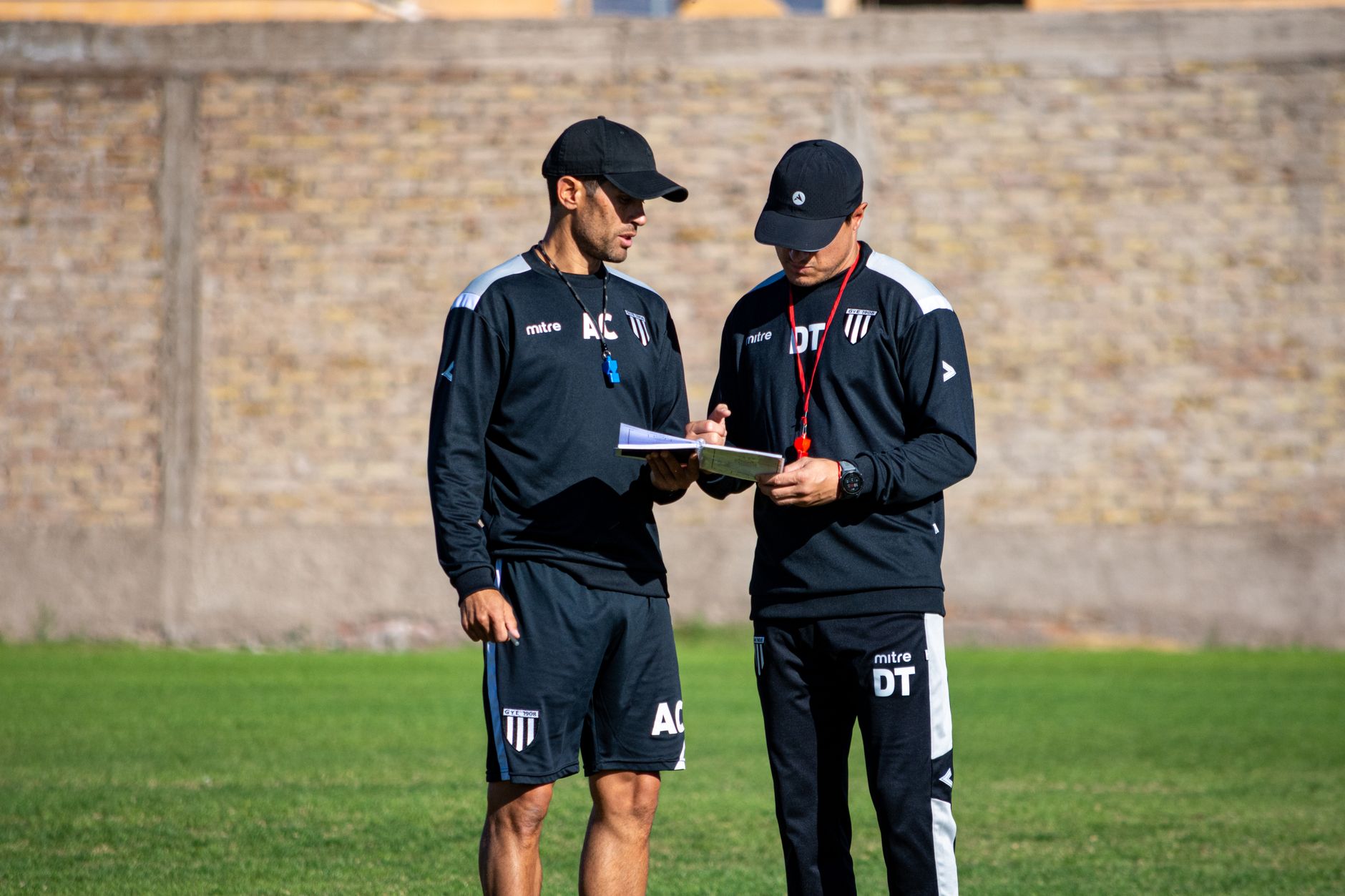
Photo by Franco Monsalvo on Pexels
Are small-sided games better than running intervals?
Small-sided games are better for combining conditioning with perception, technique, and tactical decisions, while running intervals are easier to standardise and target precisely. Neither method universally wins. A 4v4 game may replicate football chaos, whereas 6 x 30-metre sprints provide a cleaner measure of acceleration and repeat-sprint decline.
Use both intelligently. Early in a training block, intervals can establish a measurable physical base; later, small-sided games can transfer that capacity into pressing, support angles, transition, and ball retention. A coach can manipulate pitch size, player numbers, work-to-rest ratio, touch limits, and scoring rules. For example, four blocks of four minutes with two minutes of recovery creates a different stimulus from three blocks of six minutes with one minute of recovery.
A 2024 review in the Journal of Sports Sciences reported that training responses depend heavily on game format and intensity, which is precisely why vague advice such as “play more small-sided games” is incomplete. Count high-intensity actions, technical errors, and recovery between blocks. If the final game becomes a slow possession exercise, it may be excellent technical work but insufficient high-intensity conditioning.
See our football tactics and pressing guide to connect physical training with the decisions that make running valuable.
What equipment is genuinely necessary?
A stopwatch, cones, a football, resistance bands, and a notebook are enough to build a useful football fitness programme. Timing gates, GPS units, heart-rate monitors, force plates, and velocity trackers can improve accuracy, but they cannot rescue an incoherent plan. Cleats should match the surface, and footwear should be comfortable, stable, and appropriate for the player’s foot and injury history.
The FIFA Quality Programme for Football Turf explains that surface characteristics influence ball behaviour and player interaction. That matters because sprinting on natural grass, artificial turf, wet ground, and hard indoor flooring changes traction and braking demands. Do not compare a 20-metre sprint from a dry grass pitch directly with one from a hot artificial surface and assume the athlete changed overnight.
Players preparing for FIFA World Cup 2026 viewing events, amateur tournaments, or club trials should also plan around travel and heat. Los Angeles, Mexico City, Toronto, and other tournament-linked environments will present different temperatures, surfaces, and schedules. Fans joining a charity match after long travel should perform a reduced session, hydrate, and avoid treating jet lag as a character test.
For deeper preparation, explore our football match prediction and player-statistics hub, where physical availability and tactical workload help explain performance beyond headline form.
Verdict
The best football fitness training tips are not complicated, but they are exacting: build an aerobic base, train acceleration and deceleration, strengthen each leg independently, preserve technical quality under fatigue, and protect recovery as seriously as the hard work. Two demanding physical sessions per week will outperform five random workouts when intensity, timing, and progression are controlled. Football Compass uses that same logic when examining players and teams for 2026: numbers become meaningful only when placed in tactical and physical context.
Your next practical action is to record one 20-metre sprint, one 6 x 30-metre repeat-sprint session, one strength session, and your average sleep for the next seven days. Repeat the same checks at the 14-day and 28-day marks. If sprint decline exceeds 5%, soreness persists for more than 72 hours, or pain changes your movement, reduce load and seek qualified advice. If performance improves while RPE remains stable, progress only one variable—distance, repetitions, speed, or reduced recovery—during the following week. That is how we build a player who finishes matches strongly, believe it or not — I do.
Take the next step by comparing your results with football’s biggest tactical and player-performance stories.
Frequently Asked Questions
Q: What are football fitness training tips?
A: Football fitness training tips are practical methods for improving the speed, stamina, strength, agility, recovery, and movement quality required in football. The most useful plan combines aerobic conditioning, repeated sprints, acceleration, deceleration, unilateral strength, mobility, and ball work. Training should reflect position and match schedule rather than rely on generic long-distance running. Track session RPE, sprint times, sleep, and soreness so your workload can progress safely.
Q: How do I start a football fitness training programme?
A: Start with two structured sessions per week and one complete recovery day. Perform one strength session using split squats, hip hinges, calf raises, trunk work, and upper-body pushing and pulling; use the second session for acceleration, short intervals, and football drills. Begin at 70–85% of maximum effort, leave at least 48 hours between high-speed sessions, and increase only one training variable each week.
Q: What is the difference between football stamina and repeat-sprint ability?
A: Football stamina describes your capacity to continue working and recover aerobically, while repeat-sprint ability describes how well you reproduce explosive efforts with short rests. A midfielder may need strong aerobic recovery over 90 minutes, whereas a winger may require repeated 10–30 metre accelerations. Long runs can support stamina, but they do not fully train sprint mechanics, braking, or high-intensity recovery.
Q: Why does my football fitness training stop working?
A: Training often stops producing results when workload, recovery, or progression becomes inconsistent. Repeating the same 5-kilometre run does not guarantee better acceleration, and adding hard sessions while sleeping fewer than six hours can reduce performance. Re-test every 14–28 days, vary the stimulus carefully, and schedule a lighter week when soreness, RPE, and sprint decline rise together.
Q: How much does football fitness training cost?
A: Effective football fitness training can cost nothing beyond access to a safe pitch, a ball, cones, and a stopwatch. A gym membership may add roughly $20–$100 per month depending on location, while GPS trackers and timing gates can cost substantially more. Equipment should solve a specific measurement or strength problem; it should not replace coaching, progressive programming, or medical guidance.
Q: Is strength training safe for football players?
A: Strength training is generally safe for football players when exercises are taught correctly, loads progress gradually, and recovery is respected. Two weekly sessions using split squats, Romanian deadlifts, calf raises, Copenhagen planks, rows, and anti-rotation exercises can support performance. Beginners should work with a qualified coach, avoid testing maximal lifts unnecessarily, and stop when pain—not normal muscular effort—changes technique.
Q: What should I do if football fitness training causes pain?
A: Stop or modify the movement if pain is sharp, worsening, or altering your running mechanics, and seek qualified medical assessment for persistent or significant symptoms. Ordinary post-training muscle soreness usually improves within 24–72 hours, but swelling, instability, bruising, numbness, chest pain, or sudden loss of strength requires prompt professional attention. Do not use painkillers to mask symptoms and continue maximal sprinting without evaluation.
Build the numbers first, then trust the performance they produce.
Thank you for reading.
Football Compass · Latest Insights